 From my conceptual ideas comes the visuals you will see before you on Wednesday. The idea for my prosthetic came from the idea of a face as an integral part of communication and one of my favourite artists from studying art history last year. George Segal is known for his sculptures made from direct plaster casts made from live models which are left rough and white for "it's special connotations of disembodied spirit, inseparable from the fleshy corporeal details of the figure." He would then place these life sized sculptures into contexts outside the gallery for people to interact with an respond to. Where more than one figure was part of a work, they often do not interact leaving the viewer to contemplate their relationship.
Image: Three Figures and Four Benches, 1979
 The concepts he explored around gestures, stances, statures as well as the inner psychology or spiritual condition I felt linked nicely to my conceptual ideas around communicating through body language and disembodying and representing the inner psychology of emotions. I have chosen to visually represent emotions and have chosen to adapt a similar method to Segal by creating a plaster cast of my face to act as my prosthetic. As it will be molded to my face, I feel it will represent a part of me.
Image: Girl Resting, 1970
 So following discussion with James and Ryan, a trip to Gordon Harris for some plaster, and a bit more research online, I was ready to get completely plastered on Saturday. Unfortunately this is no one man task and due to lack to communication on my part, my parents misunderstood exactly what I wanting, thinking I was wanting to make a mold of my face (i.e. a
 negative) where I wanted more of a mask (a positive). Regardless, it was an interesting and perhaps slightly gross experience which involved covering my face in Vaseline, eyes in glad wrap and breathing through straws in my nose for half an hour while the plaster soaked gauze strips set on my face. The final result required a slight haircut to detach
 from my face and is mostly a strange rough textured mass of plaster, perhaps in a more abstract representation of the face. It is not an experience I am in no hurry to redo...regardless found myself with a faceful of plaster again tonight. Fun for the whole family! Round two was more successful and just needs to be a bit refined and sculpted.
Where the classical whiteness and gesture to Segals' sculptures is to suggest isolation and solitude, I chose to use it to represent the universal underlying emotions of humans. The face is something all people can identify and associate with where the whiteness leaves it unspecific, ambigious, serving as blank slate free of connotations to act as my prosthesis.
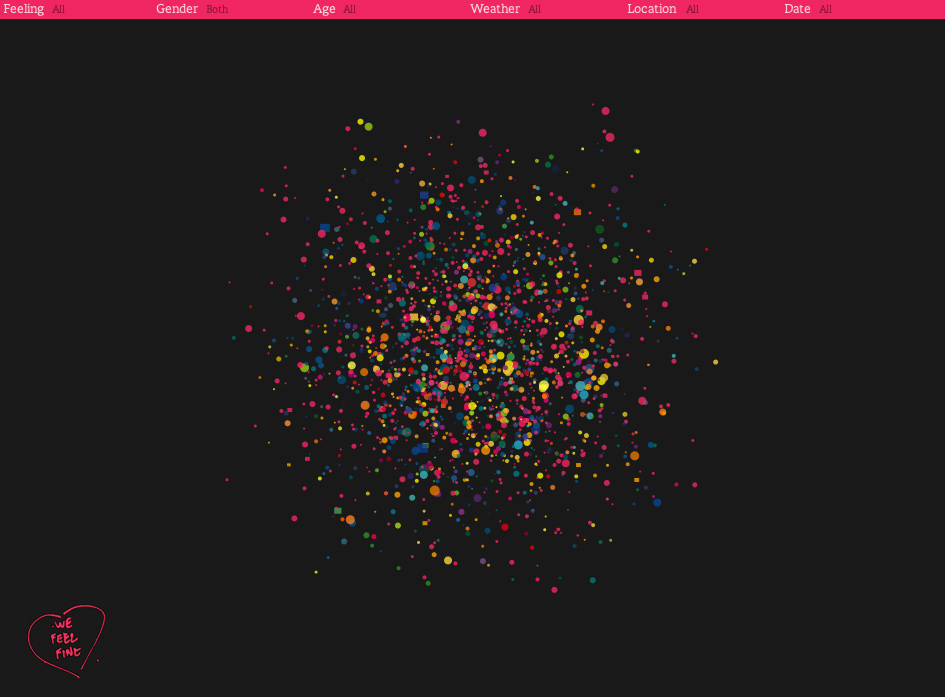
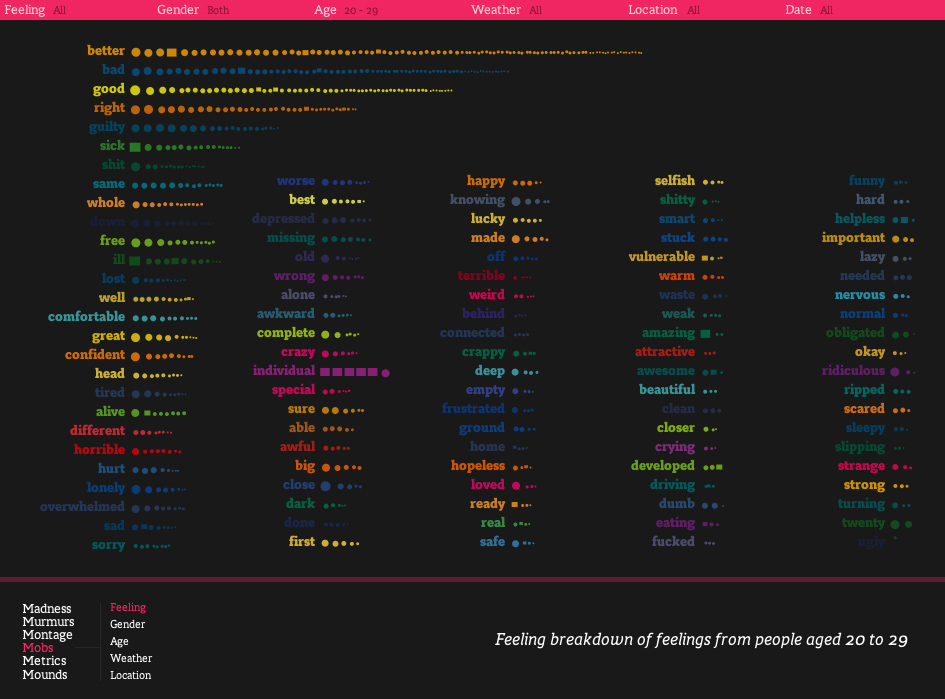
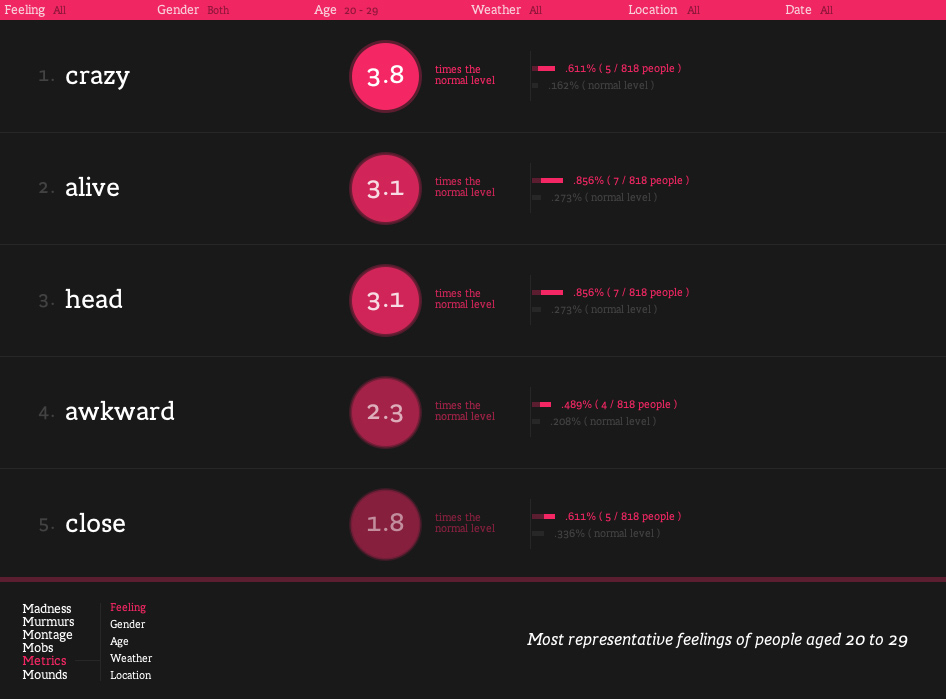
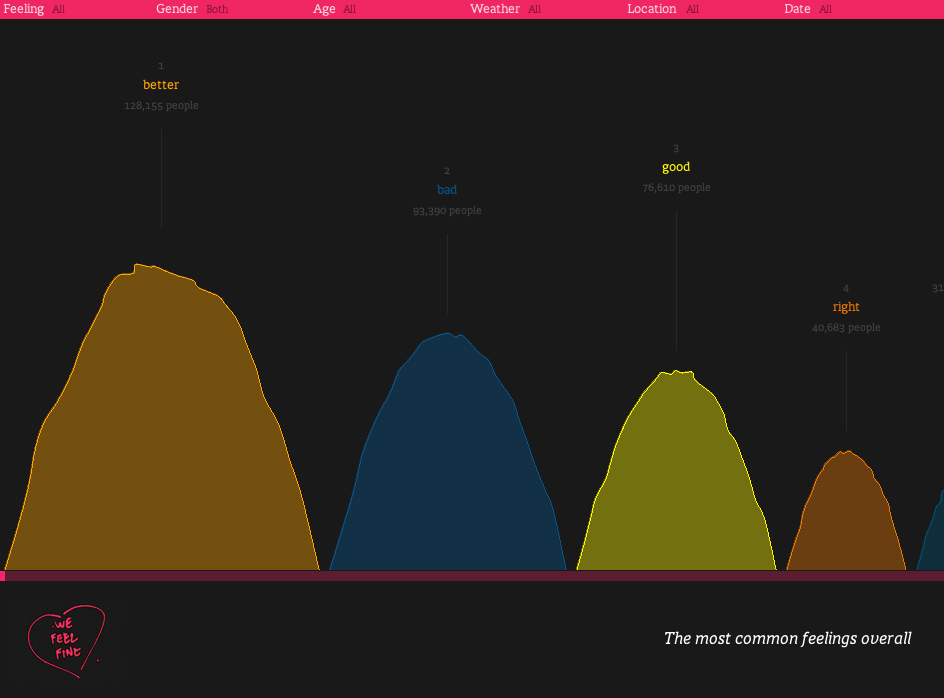
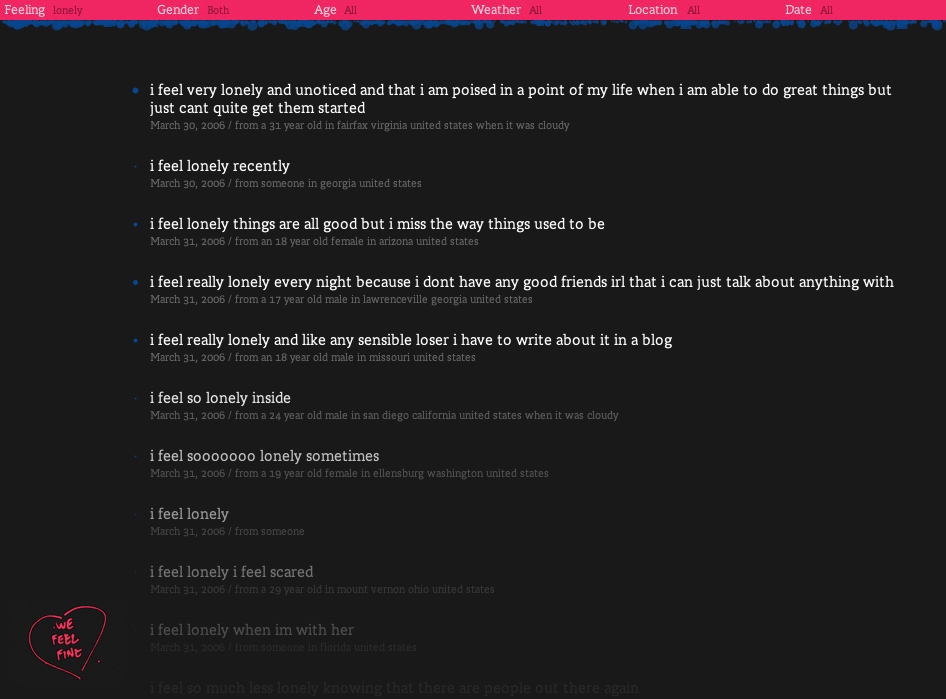
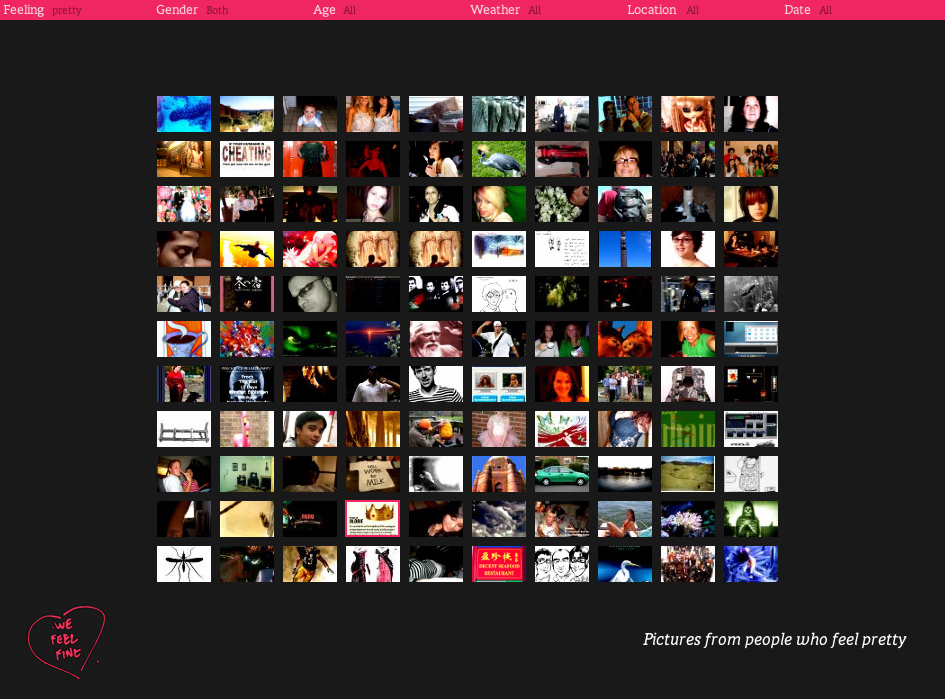
It is then rather my videos which act to evoke the emotion which the face doesn't. I was inspired by a project called 'We Feel Fine' - "An Exploration of Human Emotion." This was something I discovered and felt inspired by about a year or so ago. It scours the internet every 10 minutes searching blogs for the statement "I feel". It then identifies the sentence with a preidentified emotion based on adjectives and adverbs and links the emotion to the persons' age, gender, locality and weather conditions of locality which it then organizes into six 'movements'.
Each movement is a different visual representation of emotions to express different ideas, such as 'madness' which depicts each emotion as a coloured particle, all swarming around the screen as a 'birds eye view of humanity' which I feel conveys the dynamic range of emotions felt at any given time all over the world. 'Mobs', 'metrics', and 'mounds' present a more organized system of data around frequency and sample population which help draw meaning and conclusions from the findings.
The two movements which I have chosen to work from are 'murmurs' and 'montage'. Murmurs presents a scrolling list of human feelings in strict formal constriants which I feel reflect my my idea of the difficulty in conveying emotion in a purely textual medium. Rather montage is a more effective movement as it displays and images posted with the sentences to visually depict the emotion.
To adapt these idea, I sourced from a variety of creative commons images on Flickr, by browsing keywords in tags I collated evocative images for four out of six primary emotions. Ryan introduced me to another piece of software, 'Motion' which helped me bring them together with text and movement which help in conveying the emotions. Text was sourced from my friends' status updates on Facebook as an example of people openly expressing their thoughts and emotions through a virtual medium, open to be read and commented on. This sort of open communication I have found can form support structure for those who are feeling negative or spread positive emotions, impacting in what can be in a positive way.
With these videos finished, I have started working with the programming, trying to find ways to overlap and integrate these emotions in different intensities, depending on how the switches are controlled...


No comments:
Post a Comment